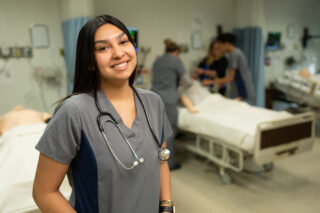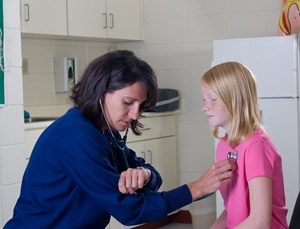
Whenever kids are injured or start to feel unwell at school, school nurses help them feel better. Whether you’ve completed a Practical Nursing program, Vocational Nursing program, or a Registered Nursing program, working as a school nurse can be rewarding if you want to combine a passion for healthcare with a love of children.
Many children have to deal with more challenging conditions than minor scrapes and bruises. There’s been an increase in the number of cases of allergies, asthma (1), and mental health disorders among students (2) in the United States, and school nurses play a vital role in the daily management of these conditions. School nurse duties include first aid, health screenings, chronic condition management, medication administration, and health education. (3)
What Is a School Nurse?
A school nurse works in an educational setting, promoting a safe learning environment by managing student injuries and illnesses, supporting student health, and coordinating with families and healthcare providers. (3)
While requirements for being a school nurse vary, the National Association of School Nurses recommends a Bachelor of Science in Nursing with pediatric experience. (4)
School nurses may work in elementary, middle, or high schools and for public or private institutions. As you begin your nursing career, consider which environment would be the best fit for you.
What Do School Nurses Do?
- Assess the severity of illness or injury in students.
- Distribute medication to students as provided and approved by parents and healthcare providers.
- Care for students with chronic conditions, including asthma, diabetes, and allergies.
- Document that students are up to date on vaccinations and immunizations.
- Screen students for vision, hearing, and other health issues.
- Prevent the spread of communicable disease within the school.
- Connect students and families to relevant health resources.
- Provide mental health support.
- Promote overall school community health. (3)
What Is the Difference Between a Nurse and a School Nurse?
School nurses have the same credentials as other nurses. While many nurses work in healthcare facilities, school nurses work in academic settings, primarily with children or adolescents. As the primary healthcare providers for the school, school nurses have the authority to make independent decisions that impact the health and wellness of the student body. (5)
How to Become a School Nurse
- Earn a Bachelor of Science in Nursing or an Associate Degree in Nursing. A Bachelor of Science is often required for state-level certification.
- Take and pass the NCLEX-RN exam, which is required for most state certifications. (6)
- Gain experience in clinical settings, ideally in pediatrics, emergency, or public health settings.
- If you have completed a BSN, consider taking the National Certification Examination for School Nurse after completing the clinical practice requirement of a minimum of 1,000 hours worked within the three years prior to taking the test. (7)
What Skills Are Important for School Nurses?
- Strong organizational and time management skills.
- Excellent communication skills.
- A commitment to continuing education.
- A comprehensive understanding of common pediatric conditions.
- A willingness to advocate for a healthy school environment. (7)
Is Becoming a School Nurse Right for You?
If you love working with children and have a passion for healthcare, school nursing may be right for you. Carrington College offers a range of educational pathways for students interested in pursuing nursing careers, including:
- Practical Nursing Program
- Vocational Nursing Program
- Registered Nursing Program
- Nursing Bridge Programs
- Bachelor of Science in Nursing Program
Which program is right for you? Compare nursing programs and find out!
FAQs
Are school nurses real nurses?
Yes. School nurses must possess a nursing degree, typically a Bachelor of Science in Nursing. (4)
Can you be a school nurse without a degree?
You cannot be a school nurse without a degree. The National Association of School Nurses recommends a Bachelor of Science as the baseline degree required to safely practice school nursing. (8)
What is the hardest part of being a school nurse?
School nurses must deal with high student-to-nurse ratios and be comfortable making clinical decisions independently.
Do school nurses get paid in the summer?
Whether a school nurse gets paid a 10-month or 12-month salary depends on their school district’s payroll structure.
What do school nurses wear?
School nurses generally wear clinical scrub bottoms with casual tops and comfortable walking shoes.
References
- Pate, C. A., Zahran, H. S., Malilay, J., & Hsu, J. (2022). The shifting prevalence of asthma and allergic disease in United States children. Annals of Allergy, Asthma & Immunology, 129(4), 481–489. https://doi.org/10.1016/j.anai.2022.06.030 a
- Centers for Disease Control and Prevention. (2024, November 29). Poor mental health effects adolescent well-being. U.S. Department of Health and Human Services. https://www.cdc.gov/healthy-youth/mental-health/index.html a
- National Association of School Nurses. (2025, February). What school nurses do. https://www.nasn.org/advocacy/advocacy-what-school-nurses-do a b c
- National Association of School Nurses. (2021). Education, licensure, and certification of school nurses [Position statement]. https://www.nasn.org/nasn-resources/professional-practice-documents/position-statements/ps-education a b
- National Association of School Nurses. (n.d.). Code of ethics. https://www.nasn.org/nasn-resources/codeofethics a
- National Council of State Boards of Nursing. (n.d.). NCLEX. https://www.nclex.com/ a
- National Board for Certification of School Nurses. (n.d.). How do I become a nationally certified school nurse (NCSN)? https://www.nbcsn.org/certification/how-do-i-become-nationally-certified-school-nurse-ncsn a b
- National Association of School Nurses. “National Association of School Nurses (NASN) Position Statement: School Nurse Education and Competency Standards for Entry into the Specialty of School Nursing.” The Journal of School Nursing, 30 July 2026. SAGE Journals, https://doi.org/10.1177/10598405261473650 a