
Registered Nursing
Carrington College’s Associate Degree in Nursing programs prepare graduates for a career in registered nursing.

Request Information
All fields using an asterik (*) are required.
Request Information
All fields using an asterik (*) are required.
Program Details
What Will I learn
Upon completion of the Associate Degree in Nursing program (Registered Nursing), graduates will be able to:
- Justify a plan of care that provides safe, quality patient centered care to persons throughout the lifespan and
across the health/wellness continuum that creates an environment promoting caring and professionalism
with consideration for the patient’s cultural/societal beliefs and practices. - Apply scientific evidence-based knowledge to concepts in the care of patients throughout the lifespan and
across the health/wellness continuum. - Validate effective communication and behaviors with healthcare stakeholders that is consistent with the
nursing scope of practice and adhering to legal and ethical frameworks.
Military Policy
Challenge / Advanced Placement for Military Trained Healthcare Personnel Requesting Entrance into the Registered Nursing program
Individuals who have held Military Health Care Occupation, specifically: Basic Medical Technician Corpsman (Navy HM or Air Force BMTCP), Army Health Care Specialist (68W Army Medic) or Air Force Independent Duty Medical Technician (IMDT 4N0X1C), may achieve advanced placement into the nursing program with documentation of education and experience qualifying them for the specific Military Health Care Occupation and upon successful completion of the challenge exam(s), dosage calculation exam, and skills competency exam.
A qualified military professional must:
- Be active in good standing (or) have been discharged under “honorable” condition.
- Submit credits earned through college course work or military experience for an applicable Military Health Care Occupation achieved
Credits Earned by Students Receiving Veterans Affairs (VA) Benefits
Incoming students receiving Veteran’s Affairs benefits will have any previous college coursework or training (military and non-military) evaluated to determine whether the previously earned credit may be transferred into their program of study.
Applicants/Military Professionals Challenging LVN Coursework and Licensure Requirements
The Registered Nursing – LVN to RN Bridge program does allow applicants to challenge the LVN coursework and licensure requirements. To successfully do so, applicants must:
- Achieve a benchmark equivalent National Standard for ATI Fundamentals Proctored Assessment to establish foundational knowledge base.
- Achieve a minimum score of 75% on the Final Exam for RN10 and RN10L.
Carrington College has well defined policies and procedures that govern the acceptance of credit for coursework completed at other institutions, including military education and training for Veterans Administration students. Please refer to the Transfer Credit Policy in the academic catalog for further details.
Cost & Financial Aid
Your education is an investment in your future, and Carrington College is here to help. We offer a variety of financial aid options, including federal, state, and private programs, as well as student loans, grants, and scholarships are available for those who qualify. Each program has different requirements and application instructions. Our team is here to guide you through the options and application process.
Academic Cost
For complete details on current tuition costs, please refer to the Academic Catalog.
Compare programs
Once you have decided you want to pursue a rewarding career in the nursing field, choosing the right job path and career education is the next step.
Location Availability
Carrington College offers the Associate Degree in Nursing program (Registered Nursing) at 9 campuses in four states. To learn more about each location, explore their pages.
Accreditation & Approvals
Carrington College is accredited by the Accrediting Commission for Community and Junior Colleges, 428 J Street, Suite 400, Sacramento, CA 95814; 415 506 0234 an institutional accrediting body recognized by the Council for Higher Education Accreditation and the U.S. Department of Education. Additional information about accreditation, including the filing of complaints against member institutions, can be found at accjc.org.
For comprehensive information on Carrington College’s accreditation and approvals, visit carrington.edu/accreditation-and-approvals/.
The Associate Degree in Nursing program at Carrington College at the campus located in Albuquerque, New Mexico is accredited by the: Accreditation Commission for Education in Nursing (ACEN), 3390 Peachtree Road NE, Suite 1400 Atlanta, GA 30326, 404-975-5000. The most recent accreditation decision made by the ACEN Board of Commissioners for the Associate Degree in Nursing program is Continuing Accreditation.
View the public information disclosed by the ACEN regarding this program at www.acenursing.org/search-programs/.
The Associate Degree in Nursing program at Carrington College at the campus located in Phoenix, Arizona is accredited by the Accreditation Commission for Education in Nursing (ACEN), 3390 Peachtree Road NE, Suite 1400, Atlanta, Georgia 30326, 404-975-5000. The most recent accreditation decision made by the ACEN Board of Commissioners for the Associate Degree in Nursing program is Continuing Accreditation.
View the public information disclosed by the ACEN regarding this program at www.acenursing.org/search-programs/.
The Associate Degree in Nursing program at Carrington College at the campus located in Mesa, Arizona is accredited by the Accreditation Commission for Education in Nursing (ACEN), 3390 Peachtree Road NE, Suite 1400, Atlanta, Georgia 30326, 404-975-5000.
The most recent accreditation decision made by the ACEN Board of Commissioners for the Associate Degree in Nursing program is Continuing Accreditation.
View the public information disclosed by the ACEN regarding this program at www.acenursing.org/search-programs/.
The Associate Degree in Nursing program at Carrington College at the campus located in Reno, Nevada is accredited by the: Accreditation Commission for Education in Nursing (ACEN), 3390 Peachtree Road NE, Suite 1400, Atlanta, Georgia 30326, 404 975 5000.
The most recent accreditation decision made by the ACEN Board of Commissioners for the Associate Degree in Nursing program is Continuing Accreditation.
View the public information disclosed by the ACEN regarding this program at www.acenursing.org/search-programs/.
Effective April 23, 2025, the Associate Degree in Nursing program at Carrington College at the campus located in Las Vegas, Nevada is a candidate for initial accreditation by the Accreditation Commission for Education in Nursing (ACEN), 3390 Peachtree Road NE, Suite 1400, Atlanta, Georgia 30326, 404 975 5000. View the public information disclosed by the ACEN regarding this program at https://www.acenursing.org/searchprograms/.
The Associate Degree in Nursing program at Carrington College at the campus located in Tucson, Arizona is accredited by the: Accreditation Commission for Education in Nursing (ACEN), 33 Peachtree Road NE, Suite 1400, Atlanta, Georgia 30326, 404-975-5000.
The most recent accreditation decision made by the ACEN Board of Commissioners for the Associate Degree in Nursing program is Continuing Accreditation.
View the public information disclosed by the ACEN regarding this program at www.acenursing.org/search-programs/.
The Arizona Board of Nursing certifies that the Phoenix and Tucson campus has satisfactorily fulfilled requirements and are granted full approval. Board offices: 1740 West Adams Street, Suite 2000, Phoenix, AZ 85007, 602 771 7800.
The Arizona Board of Nursing certifies that the Mesa campus has full approval with a voluntary consent for probation. Board offices: 1740 West Adams Street, Suite 2000, Phoenix, AZ 85007, 602 771 7800.
Carrington College holds full approval for its Practical Nursing program and its associate degree professional nursing education program. The Idaho Board of Nursing issued a certificate of approval. Board offices are located at the Division of Occupational & Professional License (DOPL), 11341 West Chinden Blvd., Boise, ID 83714. Their mailing address is DOPL, P.O. Box 83720, Boise, ID XXXXX0063 . The Idaho Board of Nursing’s website is www.ibn.idaho.gov. Questions may be directed to HP-Licensing@dopl.idaho.gov or 208 577 2476.
The New Mexico Board of Nursing certifies that Carrington College is granted full approval to offer Associate Degree in Nursing in the State of New Mexico, 6301 Indian School NE, Suite 710, Albuquerque, NM, 87110; mailing address PO Box 3628, Albuquerque, NM 87190, 505 841 8340, www.bon.nm.gov.
Carrington College’s Reno and Las Vegas Associate Degree in Nursing program has full approval from the Nevada State Board of Nursing. The address for the Nevada State Board of Nursing address is 5011 Meadowood Mall Way, Suite 300 Reno, NV 89502, 775 687 7700, nevadanursingboard.org. The Nevada State Board of Nursing can be contacted at nursingboard@nsbn.state.nv.us. Upon graduation from the Associate Degree in Nursing program, students are eligible to sit for the state licensing exam, which is required to achieve the Registered Nurse licensure.
The Oregon State Board of Nursing has granted initial approval for the Associate Degree in Nursing Program. 17938 SW Upper Boones Ferry Road, Portland, OR 97224. 971 673 0685 or email Oregon State Board of Nursing.
State Approvals
CALIFORNIA
Carrington College is a private institution and is approved to operate as an accredited institution by the California Bureau of Private Postsecondary Education (BPPE). Approval to operate means that SJVC has been found in compliance with the standards set forth in the California Private Postsecondary Education Act of 2009 (as amended) and Title 5, Division 7.5, – Private Postsecondary Education of the California Code of Regulations. As a prospective student, you are encouraged to review this catalog prior to signing an enrollment agreement. You are also encouraged to review the School Performance Fact Sheet, which must be provided to you prior to signing an enrollment agreement.
A student or any member of the public may file a complaint about this institution with the Bureau for Private Postsecondary Education by calling (888) 370-7589 or by completing a complaint form, which can be obtained on the Bureau’s internet website (www.bppe.ca.gov).
Course Catalog
The Associate Degree in Nursing program at Carrington College comprises three educational areas:
- Clinical
- Administrative
- Externship
For complete program information, please take a look at the Course Catalog.
Program Specific Disclosures
The Accreditation Commission for Education in Nursing (ACEN) requires that the following student achievement outcome data be made publicly available.
- Graduates’ success on the licensure and/or certification examination
- Students’ completion of the nursing program
- Graduates obtaining a job
To view this information for Carrington College’s ACEN – accredited nursing programs, click here.
Continuing Education For Graduates
Student Outcomes

REAL WORLD SKILLS
With many classes to guide you, you’re certain to be prepared for your career.

START YOUR PATH
Earn your Associate Degree in Nursing (Registered Nursing) in as few as 23 months.

FLEXIBLE LEARNING OPTIONS
Conveniently available at 9 of our campuses.

AFFORDABLE TUITION
Affordable tuition varies by program and location.
Since I started my ADN program, a lot has changed around the house. I think [I’ve] become more independent and resilient as a result. And knowing that my husband and the girls are proud of what I’ve accomplished feels really great.
ANGELA K.
2021 GRADUATE, ASSOCIATE DEGREE IN NURSING
Registered Nursing Core Competencies
Students enrolled in registered nursing programs work toward building the knowledge and clinical judgment needed for professional nursing practice. The curriculum combines classroom instruction, simulation learning, and supervised clinical experiences designed to help students develop practical nursing skills.
Students may develop competencies in several core areas:
- Patient Assessment and Care Planning: Students learn how to collect patient health information, monitor conditions, and participate in developing care plans that support patient safety and recovery.
- Clinical Nursing Procedures: Hands-on practice helps students build confidence performing nursing tasks commonly used in healthcare environments under the supervision of licensed professionals.
- Communication and Team Collaboration: Nurses work closely with physicians, healthcare providers, patients, and families. Coursework emphasizes clear communication and collaborative decision-making within healthcare teams.
- Patient Education and Advocacy: Students learn how nurses help patients understand treatment plans, medications, and preventive care practices.
These competencies help prepare students pursuing an RN associate degree to participate in patient care across a range of healthcare settings.
What Will I Learn?

Pharmacology

Maternal Child Nursing

Medical Surgical Nursing

Community and Mental Health Nursing
Career Opportunities
Registered nurses have more authority and need less supervision while they work. According to the U.S. Bureau of Labor Statistics, most registered nurses work as part of a team with physicians and other healthcare specialists, and some oversee licensed practical nurses, nursing assistants, and home health aides. (1)
Specific job duties will vary by employer and employment setting. For example, an RN working in a residential care facility would have different duties than a nurse working in an emergency department.
Some typical job duties of an RN may include: (1)
- Assess patients’ conditions
- Record patients’ medical histories and symptoms
- Observe patients and record the observations
- Administer medications and treatments
- Develop or contribute to patient care plans
- Collaborate with doctors and other healthcare professionals
- Operate and monitor medical equipment
- Assist with diagnostic tests and analyze results
- Teach patients and their families how to manage illnesses or injuries
- Explain what to do at home after treatment
If you’d like to explore more about potential roles and responsibilities, visit our Nursing Career Guide.
Designed for Clinical Readiness and Professional Practice
The Associate Degree in Nursing program at Carrington College is designed to help students build confidence through a combination of classroom learning and hands-on training experiences.
As part of the School of Nursing, students in the Associate Degree in Nursing program benefit from learning environments that emphasize practical skill development and supervised clinical practice.
Program strengths:
- Multiple Supervised Clinical Rotations: Students participate in clinical learning experiences where they apply nursing concepts while working with patients under professional supervision.
- Practice in Diverse Healthcare Environments: Clinical rotations may include exposure to acute care, long-term care, and community healthcare settings.
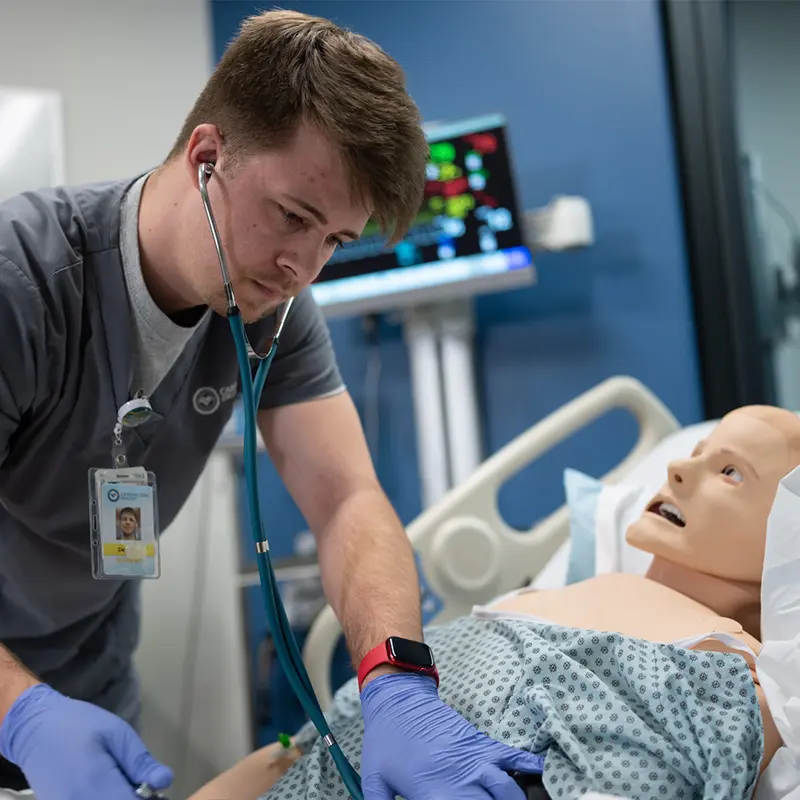
- Simulation-Based Learning: Simulation labs provide opportunities for students to practice nursing procedures in controlled environments before participating in patient care during clinical rotations.
- Real-World Patient Care Experience: Under the supervision of instructors and healthcare professionals, students gain experience assisting with patient care activities in clinical settings.
- Student Support Resources: Academic support services may include faculty guidance, simulation preparation, and resources designed to help students prepare for professional nursing responsibilities.

Registered Nursing
At the School of Nursing
Talk to an enrollement services representative about your options and earn your Associate Degree in Nursing in as few as 23 months.
Successful Nursing Program Grads
Ask one of our graduates about their Carrington College experience and they’ll likely describe it as life-changing.
Discover What It’s Like to Train to Become a Nurse at Carrington College
Explore The School of Nursing

Student Life
The passion our students bring to their education is real. At Carrington College, we want to keep that passion going far beyond our learning experience.

All Nursing Programs
There are many different nursing programs to choose from, so you can select the career path that best suits your personal and professional goals.
Compare Programs
Once you have decided you want to pursue a rewarding career in the nursing field, choosing the right job path and career education is the next step.

Nursing Resources
Whether you’re just starting out in nursing, or taking your education to the next level, there are plenty of nursing student resources to assist you.

FINANCIAL SERVICES
Figuring out how to pay for your education can be intimidating, but we’re here to help! Student loans, grants, and scholarships are available to those who qualify.
Registered Nursing Program FAQs
-
ADN stands for an Associate Degree in Nursing. It is a degree program designed to prepare students for a career as a registered nurse.
An ADN program focuses on foundational nursing knowledge and patient care skills, including areas such as pharmacology, surgical nursing, and community and mental health nursing.
After completing an ADN program, graduates may pursue licensure by taking the National Council Licensure Examination for Registered Nurses (NCLEX-RN)* to become a registered nurse (RN). Carrington College prepares students to take appropriate certification and licensure exams related to their program of study; however, the College does not guarantee students will pass these exams or become licensed.
-
An associate degree in nursing can help prepare you to pursue licensure as a registered nurse (RN). After completing a program, graduates may take the National Council Licensure Examination for Registered Nurses (NCLEX-RN)* to become licensed.
Graduates may pursue registered nursing roles in a variety of healthcare environments, depending on licensure requirements and state regulations. As an RN, responsibilities may include assessing patients’ conditions, documenting health information, administering medications and treatments, and collaborating with physicians and other healthcare professionals. Duties can vary depending on the work setting and employer.
-
The length of the program varies by institution and program structure. Many registered nursing programs are designed to be completed in approximately two years of full-time study, though program timelines may vary depending on course scheduling and individual academic progress.
Students pursuing an associate degree in nursing should review specific program timelines with their school to understand the expected duration.
-
While both roles are essential to the healthcare team, their education and scope of practice have distinct differences:
- Practical or Vocational Nurses (LPN/LVN): Typically complete a certificate or diploma program (usually 12 months) focused on foundational patient care, such as monitoring vitals, administering basic medications, and ensuring patient comfort. (2)
- Registered Nurses (RN): Complete advanced education, such as an associate degree in nursing (ADN), which prepares them for a broader scope of responsibility. RNs are trained to perform complex patient assessments, initiate and modify care plans, and lead the coordination of care with physicians and other healthcare specialists. (1)
The transition from LPN/LVN to RN reflects a shift toward increased clinical responsibility, critical thinking, and complex care coordination. (1) (2)
-
An RN (registered nurse) and a BSN (bachelor of science in nursing) are not the same type of credential, so one is not necessarily “higher” than the other.
- RN refers to a professional nursing license earned after completing an approved nursing program and passing the NCLEX-RN exam.
- BSN is a bachelor degree in nursing that builds on foundational nursing education with additional coursework in areas such as leadership, healthcare systems, and evidence-based practice.
In other words, you must become a licensed RN to practice nursing, and a BSN is an educational pathway that may support expanded knowledge and responsibilities in the field. Compare Carrington College’s nursing programs to see which one is the right fit for you.
-
Admission requirements for registered nursing programs may vary by institution, but common steps can include:
- Passing the ATI TEAS Admission Assessment with a minimum qualifying score
- Attending an Associate Degree in Nursing information session
- Providing required documentation, such as proof of immunizations, where applicable, based on state or campus requirements
Additional requirements may apply depending on the program and location. Prospective students can review full admissions details in the Academic Catalog.
-
Graduates of an associate degree in nursing program may become eligible to apply for the NCLEX-RN, depending on state licensing requirements.
The RN associate degree curriculum is designed to help students develop nursing knowledge and clinical judgment, including concepts aligned with clinical judgment models used in licensure evaluation. (3)
Students should review state licensing requirements to understand the full steps required to become a registered nurse.
-
Yes. Hands-on learning is an important component of most registered nursing programs. Carrington College nursing programs include hands-on learning experiences designed to help students apply classroom knowledge in practical settings.
Students participate in supervised clinical experiences and simulation activities that support the development of clinical reasoning, technical skills, and professional behaviors. (4)
Clinical and simulation experiences are guided by faculty and may vary by program and location.
References:
- U.S. Bureau of Labor Statistics. “Registered Nurses.”
https://www.bls.gov/ooh/healthcare/registered-nurses.htm - U.S. Bureau of Labor Statistics. “Licensed Practical and Licensed Vocational Nurses.”
https://www.bls.gov/ooh/healthcare/licensed-practical-and-licensed-vocational-nurses.htm - National Council of State Boards of Nursing (NCSBN). “Clinical Judgment Measurement Model and Nursing Regulation & Scope of Practice.” https://www.ncsbn.org
- Carrington College. “Nursing Student Handbook (Volume IV).”
https://docs.carrington.edu/handbooks/Nursing-Handbook-IV.pdf -
Disclosure:
*Carrington College prepares students to take appropriate certification and licensure exams related to their individual majors. The College does not guarantee students will successfully pass these exams or be certified or licensed as a result of completing the program.