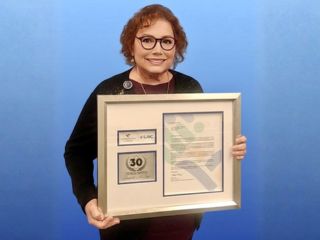
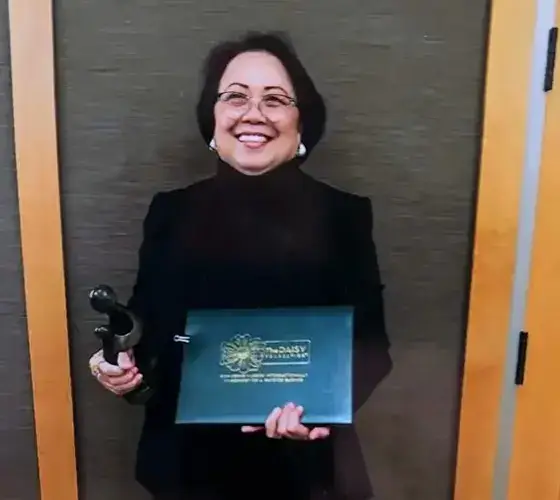
 With medical doctors in Ida Romelle Flores’ family, she felt both a responsibility and calling to serve her community and a deeply centered love to follow those giant footsteps into the medical field. But she never imagined that her years of nursing education and practice in both the Philippines and the U.S. would lead her to the front of a classroom and simulated medical laboratories, teaching others how to provide the best nursing care to those in need. Ida was awarded the DAISY Award earlier this year. Her students have described her as an excellent nurse and a fantastic professor, and she has taught them to believe in themselves and strive to be the best version of themselves.
Carrington College’s Vocational Nursing program in Sacramento is her stage, teaching the next generation of health care providers is her love and successful graduates are her legacy.
What was your early introduction to a medical career?
I grew up in a medical family that extended through generations. My father and several uncles, aunts and cousins were doctors, nurses, dentists and pharmacists. My greatest influence was my dad (the first and most influential doctor in the family), who taught me compassion for the less fortunate in our community in the Philippines. He set an example for us all, and his passion became my passion.
How did your father’s passion for medicine and those patients he served affect you?
My father was very involved in medical missions. He was very civic-minded and the character trait I took from him was compassion and dedication towards his medical practice. When he died in the Philippines, thousands of people were at his vigil.
What is your formal medical training and work scope?
I finished my BSN (Bachelor of Science in Nursing) when I was 20-years old and worked in my Dad’s clinic until I got my nursing license. I’ve worked as a school nurse, a company nurse, in a mid-wife school and a maternity hospital. At 25-years old I was hired as an instructor by a university with 30,000 students (Philippines) and then became a Clinical Nursing instructor in a Registered Nursing program. But I always really wanted to be both a nurse and a teacher. I have been a clinical instructor at Carrington College’s Vocational Nursing program for 12-years.
Do you have strong family support for your teaching career?
My family is my husband, Louis, 5 children and 12 grandchildren.
What excites you about teaching?
My passion is to set the standard for nurses to have a safe nursing practice. I want to instill in my students a high level of safe practice and integrity. They are watching me, and I want to give them a good role model.
What is your teaching style?
I’m nice, but strict. I set a high standard. I want to prepare my students for the next level of their program. I expect them to learn the subject matter in preparation. Over the years, I’ve learned what works and what doesn’t work. Their skill levels and performance steadily develop and are observable.
What is your greatest emphasis as a teacher?
Professionalism is very important in this field, and I must curb behaviors that might lead to negligence. I want our nursing students to be successful, so I set professional behavior and standard practices for them to follow. They must clearly understand that when you’re dealing with potentially legal implications, you cannot compromise professionalism.
What do you, as a teacher, struggle with most?
The reason I am here is because I want all my nursing students to be successful. To be successful, they must set and adhere to the standards of their practice. Professionalism is very important in the field, and they must curb any behaviors that might lead them to negligence. There are legal implications to what they do, and I stress this standard for the success of their medical careers.
What inspires you to teach at your highest level?
My character holds a high moral value. I was also raised to have a strong spiritual value, as my mother was raised. No matter what I do, I must do it the best I can – without compromise. With that value, I have garnered a lot of awards in whatever I do.
My heroes are my Mom and Dad. They are the ones who formed me. And, beyond my own kids, I want to help form my students toward their own success.
Do you have a favorite moment with students/graduates?
Seeing them doing their clinicals (on-the-job training at the end of their Vocational Nursing program) and they tell me that their (externship) supervisors tell them “When you become licensed, come back and we will hie you”.
Out in the medical community I see graduates who now have high positions, such as Director of Nursing or Assistant Director of Nursing. That is my most sacred moment. Seeing graduates in those positions is very heartwarming.
How do you measure student success?
It is awesome to hear students who come back after graduation and tell me how they appreciate the way I taught them. They tell me, “Everything you said was true!” One was promoted to Nurse Supervisor only three months after they were hired – usually a position only an RN (Registered Nurse) could have.
What brings you your highest gratification?
It’s priceless to help others become a nurse. When I get to the place of sitting in my rocking chair, I will remember all these cards from so many students. They actually made me a binder of cards and photos. Making a lot of good nurses gives me so much pride. That is my passion.